


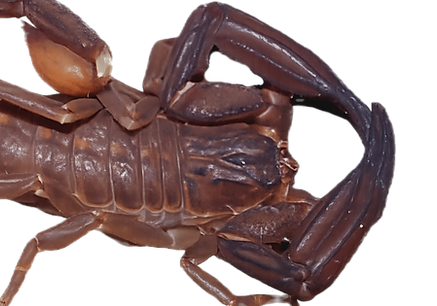
Chaerilus kautti
Chaerilus kautti is a small forest-dwelling scorpion in the family Chaerilidae, native to Southeast Asia.
It inhabits humid leaf-litter microhabitats and shelters beneath bark and stones.
Like other Chaerilus species, it is not considered medically significant to healthy adults.
HABITAT
🌍Geographic Range:
Confirmed distribution (current knowledge)
Thailand only
Prachuap Khiri Khan Province
Khao Ma Rong karst area, near the eastern coast of peninsular Thailand
Elevation: ~56 m a.s.l.
🔒 Important:
At present, Chaerilus kautti is known exclusively from its type locality.
It has not been recorded elsewhere in Thailand or in neighbouring countries in:
the original species description (Kovařík et al., 2020)
national Thai scorpion checklists
global taxonomic databases
________________________________
🌳Natural Environment:
Isolated karst limestone hill
Surrounded by heavily cultivated lowlands (oil palm plantations, eucalyptus)
Karst massif itself retains primary forest cover
Close to cave systems, but the species is not cave-adapted
📌 Authors from previous taxonomic data have stated C. kautti does not appear to be associated with caves, despite it's proximity to them.
________________________________
🌦️Climate Conditions:
This scorpion thrives in consistently moist environments, requiring humidity levels between 70% and 80%. Ideal temperatures for its natural and captive habitats range from moderate to warm, specifically between 22°C and 26°C.
________________________________
🧬Micro habitat
Documented field and captive observations include:
Observed:
On the ground
Between leaf litter
Openly on rocks
In captivity, individuals concealed themselves under:
Bark
Moss
________________________________
🏡Captive Habitat
Recommendations In captivity, the scorpion requires an enclosure designed to mimic its natural habitat. Suitable substrates include msoil that can retain moisture and cutting of 80% of ventilation, ensuring proper moisture retention and humidity. Adequate hiding spaces, such as cork bark or small logs, are essential. Regular misting maintains necessary humidity, ensuring optimal health conditions.
PHYSICAL DESCRIPTION
CAPTIVE CARE
VENOM
STATS
LATIN NAME:
• Chaerilus kautti
________________________
COMMON NAME:
• Kautti Bush Scorpion
________________________
TEMPERATURE
• 20°- 25°
________________________
TEMPERAMENT:
• Calm & Uses thanatosis
________________________
HUMIDITY:
• 80%
________________________
COMMUNAL:
• 3/5 — Conditional
________________________
SIZE:
• Up to 5cm
________________________
ECOLOGY:
• Terrestrial
________________________
SUBSTRATE:
• Soil that holds humidity
________________________
ORIGIN:
• Thailand
________________________
FACTS
TAXONOMY
Classification:
Kingdom: Animalia
Phylum: Arthropoda
Class: Arachnida
Order: Scorpiones
Family: Chaerilidae
Genus: Chaerilus
Species: Chaerilus kautti
_____________________________
Family: Chaerilidae
Chaerilidae is a distinct scorpion family containing a single living genus, Chaerilus, distributed across South and Southeast Asia. Members of this family are generally small to medium-sized forest scorpions that inhabit humid tropical environments such as leaf litter, soil burrows, and forest debris. Identification within the family typically relies on fine morphological characteristics, including trichobothrial patterns, carination, and granulation, rather than obvious external traits.
_____________________________
Genus: Chaerilus
The genus Chaerilus includes numerous species occurring throughout tropical Asia, from India and Sri Lanka to China and Southeast Asia. Species within the genus are typically cryptic, nocturnal, and strongly microhabitat-dependent, often living beneath stones, bark, or within moist soil layers of forest habitats. Morphological differences between species are often subtle, meaning accurate identification generally requires detailed examination of carapace structure, pedipalp proportions, and trichobothrial arrangement.
_____________________________
Species: Chaerilus kautti
Authority & Year
Described by František Kovařík in 2015.
_____________________________
Etymology
The species name kautti was given in honour of Peter Kautt, a German arachnologist and scorpion enthusiast who has contributed to the study and documentation of Asian scorpions.
_____________________________
Nomenclatural Notes
There are no widely accepted synonyms for Chaerilus kautti in current taxonomic literature.
The species name has remained stable since its original description.
Within the hobby, it may occasionally be confused with other Southeast Asian Chaerilus species, particularly those of similar size and general morphology, because members of this genus often exhibit very subtle external differences.
_____________________________
Phylogenetic / Taxonomic Context
The genus Chaerilus represents the sole extant lineage of the family Chaerilidae, making it taxonomically distinct among scorpions. Chaerilids are often considered a separate evolutionary lineage compared with many of the more commonly known families such as Buthidae or Scorpionidae. Their classification is supported by consistent morphological features, particularly in trichobothrial patterning and pedipalp structure, which remain stable across the genus.
_____________________________
Related / Similar Species
Within Southeast Asia, Chaerilus kautti may be discussed alongside several related or geographically nearby species within the genus, including:
Chaerilus cimrmani
Chaerilus stockmannorum
Chaerilus sejnai
Chaerilus neradorum
These species are differentiated primarily through detailed morphological comparison and locality data, as external appearance alone can be quite similar across the genus.


